
01 · FAQ
Which sandwich panel is best for a cold store?
PU or PIR, because they insulate best for their thickness and do not take up moisture the way fibrous cores can. Chillers and freezers need thicker panels than rooms kept at normal temperature.
A sandwich panel is two steel sheets bonded to an insulating core. The core you choose decides how well the panel keeps heat out, how it behaves in a fire, and what it costs.
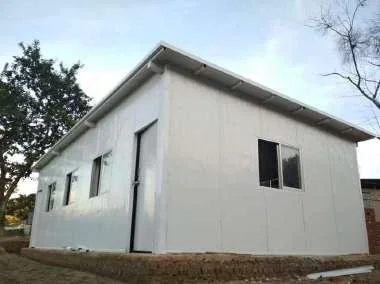
A sandwich panel has three layers: an outer steel sheet, an insulating core, and an inner steel sheet. The three are bonded together so the panel acts as one stiff piece. The outer sheet takes the weather, the core keeps heat out, and the inner sheet gives a clean finished face inside.
Because each panel is already insulated and finished on both sides, a wall or roof goes up in one step instead of three. That is why sandwich panels are used for porta cabins, site offices, cold stores, clean rooms and the walls and roofs of steel buildings.
EPS (expanded polystyrene) is the white foam familiar from packaging. It is light, cheap and a good insulator, which makes it the usual choice for cabins and general-purpose buildings. Its weakness is fire: it melts and burns.
PU (polyurethane) is a rigid foam that insulates better than EPS for the same thickness. A thinner PU panel can match a thicker EPS one, which matters in cold stores where every millimetre of wall is floor space lost.
PIR (polyisocyanurate) is a close relative of PU with a chemistry that chars rather than burning freely. It keeps PU's insulation and improves the fire behaviour.
Rock wool (mineral wool) is made from molten stone spun into fibres. It does not burn, so it is used for fire walls, plant rooms and buildings where fire safety comes first. It is heavier and needs a thicker panel to insulate as well as PU.
Thickness is the main lever on insulation. As a rough guide:
We have built sandwich-panel buildings on a steep mountain site at Balakot, and use insulated panels on porta cabins and prefab buildings and on the walls and roofs of pre-engineered buildings. Tell us what the building is for and we will recommend the core and thickness.
Typical values for the core material. The panel maker's data sheet gives the figure for a specific product.
| Core | Insulation (λ, W/m·K) | Fire behaviour | Weight | Typical uses |
|---|---|---|---|---|
| EPS | 0.033 to 0.040 | Combustible | Lightest | Cabins, site offices, general sheds |
| PU | 0.022 to 0.026 | Combustible, chars | Light | Cold stores, insulated roofs and walls |
| PIR | 0.022 to 0.026 | Better fire performance than PU | Light | Cold stores, food plants, warehouses |
| Rock wool | 0.038 to 0.045 | Non-combustible | Heaviest | Fire walls, plant rooms, high-risk buildings |
A lower λ (lambda) means better insulation. The same insulation needs a thicker rock wool panel than a PU or PIR panel.
PU or PIR, because they insulate best for their thickness and do not take up moisture the way fibrous cores can. Chillers and freezers need thicker panels than rooms kept at normal temperature.
Only rock wool cores are non-combustible. EPS and PU burn, and PIR behaves better in a fire than PU. Where fire safety is critical, use rock wool, or check the fire rating of the specific panel.
For a cabin or site office, 50 to 75 mm is common. Air-conditioned rooms in hot climates benefit from 75 to 100 mm. Cold stores use 100 to 150 mm for chillers and more for freezers.
Yes. Roof panels have a deeper profile on the outer sheet to carry rain and loads over wider spans than wall panels.
Porta cabins, site offices, labour camps, container-style offices and prefab buildings from A&A Enterprises Engineering, built with sandwich panels or light gauge steel.
Open →PEB sheds, warehouses, factories and hangars designed, fabricated and erected by A&A Enterprises Engineering, with the civil foundation, from Karachi to sites across Pakistan.
Open →Pre-engineered steel buildings compared with conventional steel and RCC construction for factories, warehouses and sheds in Pakistan: speed, spans, cost, expansion and limits.
Open →Tell us about your site and what you need. Our team in Karachi will get back to you.